British Museum exhibition: Hieroglyphs
I recently visited the British Museum exhibition "Hieroglyphs: Unlocking Ancient Egypt" and found it broad in scope and surprisingly relevant to people with magical interest. I highly recommend seeing it in person. For those who can't, I would like to take you with me through the exhibition along several thematic paths. (Note that this is a small selection of all the exhibits, dictated by my particular interests, and that they are not presented on the exhibition in this order.)
Path 1: Hermes Trismegistos and His Students
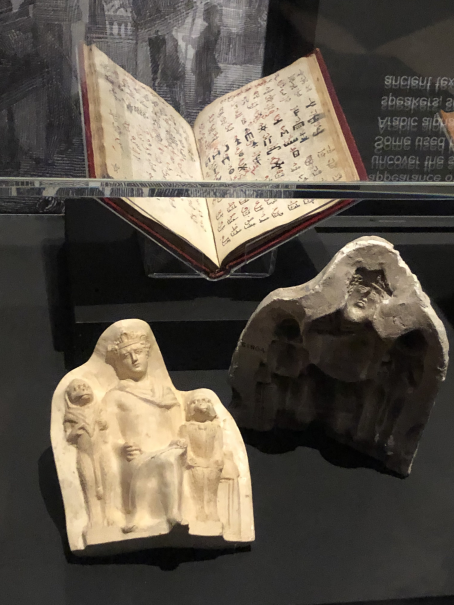
At the entrance to the exhibition, we meet the teacher himself, Hermes Trismegistos (or at least a scribe with two baboons). The mould was original, and the cast was modern. This is what I came there for. Unfortunately, there was no replica in the shop!
(I was unimpressed by the shop; it seemed to be very generic and had few replicas, unlike the one set up for "Feminine power: the divine to the demonic".)
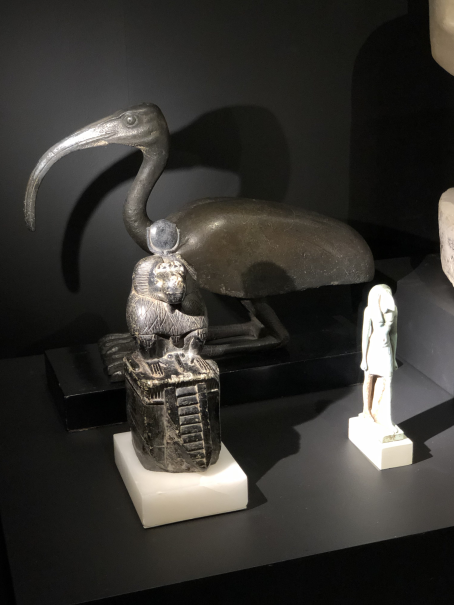
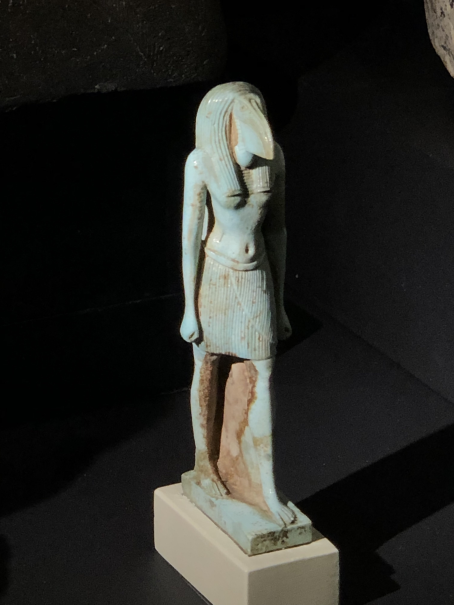
In the Egyptian section stands the god Thoth, who transformed into Egyptian Hermes, or Hermes Trismegistos. Inventor of writing, impartial judge, god of magic and of the Moon, the planet considered to be especially connected to magic.
In the surviving dialogues between Hermes Trismegistos and his students, one of the participants who is also the son of Hermes goes by the name of Tat.
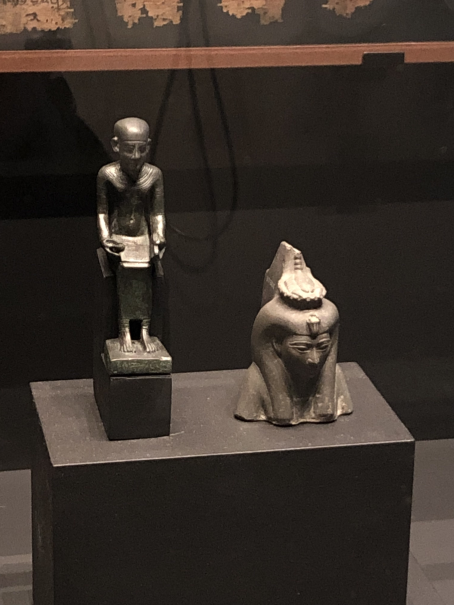
Next, Imhotep, a chancellor, high priest of Ra and pyramid architect, later deified and worshipped as a healer deity. He was syncretised with Asclepios, the Greek god of healing who also used to be a mortal.
Asclepius is the other well-known student of Hermes Trismegistos.
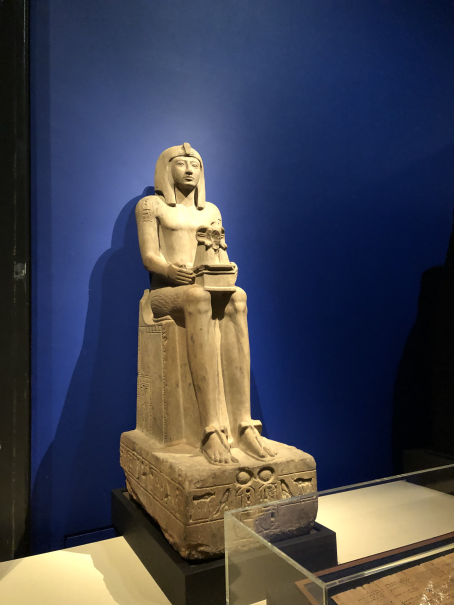
A pharaoh with a statue of god Amun on his knees.
Amun, "the hidden/invisible one", one of Ogdoad or eight creator gods, was later identified with Ra (the Sun god) as the quintessential creator god, and then also syncretised with Zeus as Zeus-Ammon. He was also the patron god of Thebes, where the largest cache of the Greek Magical Papyri was reportedly found.
.jpg)
Amun also shows up in Hermetica as King Ammon, student of Asclepius, and Hammon, student of Hermes Trismegistos.
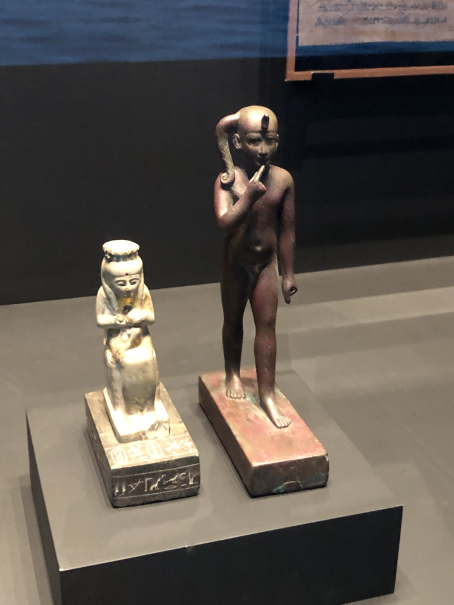
Lastly, Isis breastfeeding Horus, and Horus-the-child (forelock, finger in the mouth are both signifiers of childhood) who became hellenised as Harpocrates (from Heru-pa-khered, Horus-the-child), the god of silence. He shows up in Greek Magical Papyri.
Isis presents herself as a student of Hermes who passes on his teachings to her son. Some of the larger continuous chunks of known hermetic dialogues not written in the voice of Hermes are conversations between Isis and Horus.
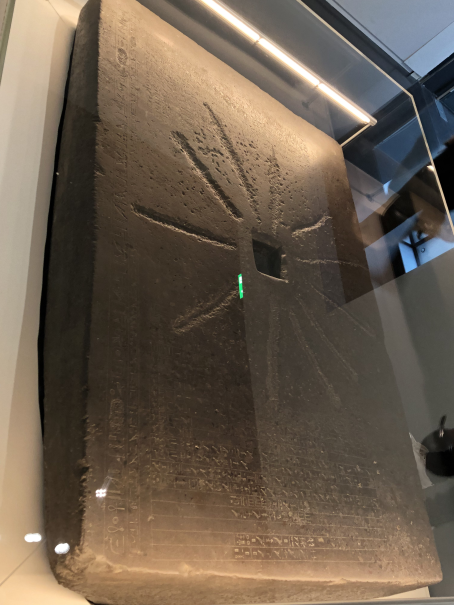
The last thing you see as you exit the exhibition is a stone, partly destroyed by later reuse, which tells a world creation story in which Ptah creates the world by reading aloud the names of gods, people, cities and temples - in other words, the world created by logos.
The stone inscription claims that a pharaoh found the story in an ancient papyrus and had it inscribed to preserve it for eternity. This motif comes back multiple times in religio-magical texts: a wise man preserves his teachings for future generations by inscribing them on something permanent - a stele (in The Discourse on the Eighth and Ninth), a column (Cyranides), or a tablet of precious stone (as in the Arabic version of Secretum Secretorum).
Path 2: Where Grimoires Come From
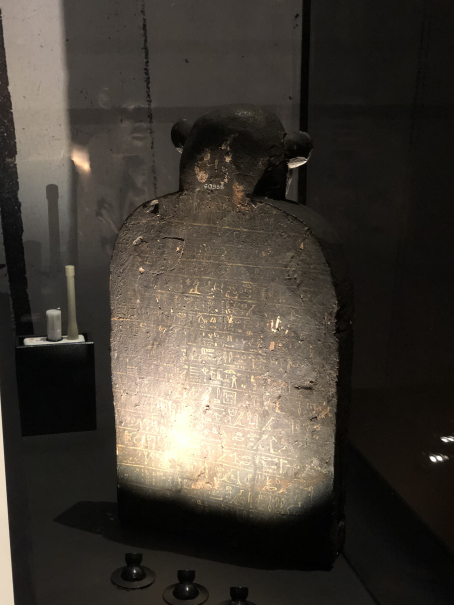
A wooden figure of god Bes, inscribed yellow-on-black. According to the description, the hieroglyphs are somewhat discoloured because water was poured over the figure and was blessed in this manner.
In the Greek Magical Papyri, which collect Egyptian spells written in Greek and Demotic, during the period of 100BCE-400CE, or roughly the Roman period, it is a common magical action to write or draw something of magical significance on a slate, wash it off and do something with the water, usually drink it.
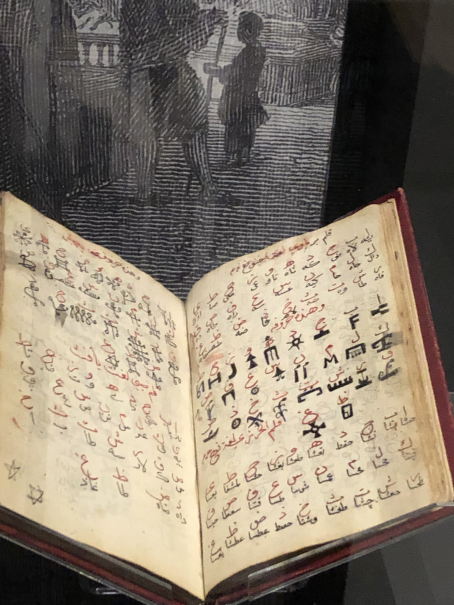
The book displayed above the statue of Hermes Trismegistos is an Islamic manuscript of various magical scripts, opened on - the label says - the script of Enoch (tradition identifies Enoch and Idris with Hermes Trismegistos). The label further says that Muslims used pseudo-hieroglyphs as magical alphabets.
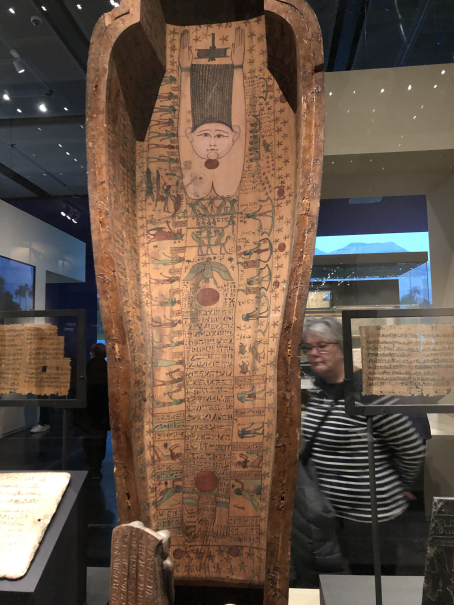
The interior of a wooden sarcophagus. The people in boats are the interesting part - if I understand the (somewhat vague) description correctly, these the decans.
Egyptian astrology split the ecliptic into 36 fragments of 10 degrees each (thus the name "decans"), which revolved in a daily and not yearly cycle. A full day's span covered the drama of the Sun god being born in the morning, descending into the underworld in the evening, then fighting to return to life and bring life to the world again with the next sunrise. The decans were portrayed as deities in their own right and had individual names, although a single authoritative list doesn't exist.
Western astrology still preserves decans, but largely translates them into places of influence of a specific planet without specific individual characteristics. In magic, decans probably inspired "planetary hours". Decans are also mentioned in hermetica alongside - or sometimes above - zodiac.
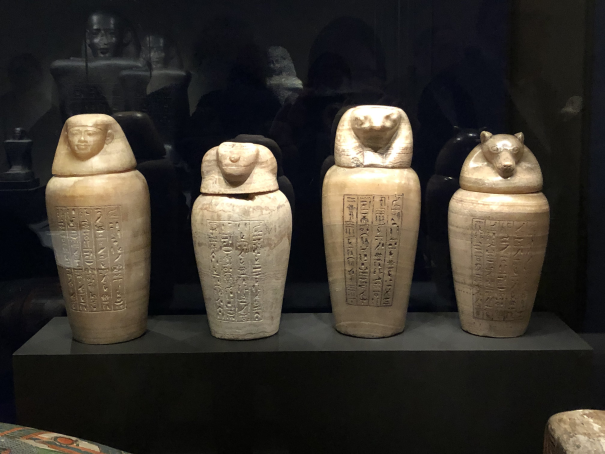
Canopic jars for preserving organs removed from the body of a mummy.
The jars represent four sons of Horus, who are also connected to directions of the world (possibly as the four supports of the heavens) which we know because the graves and coffins are oriented towards the four directions, and the sons are painted on appropriate parts of coffins. Four goddesses formed pairs with these gods (Isis with Amset, Nephthys with Hapy, Neith with Duamutef, and Selkis with Qebehsenuef.)
This particular set of jars, the description says, has been reunited for the first time since the 1700s. The mummy owner of the intestines (a woman, also present in the exhibition) must have been really annoyed in the meantime. Now that all the parts are in one place, will the Mummy rise again?
Path 3: Internet in Ancient Egypt
Ozymandias
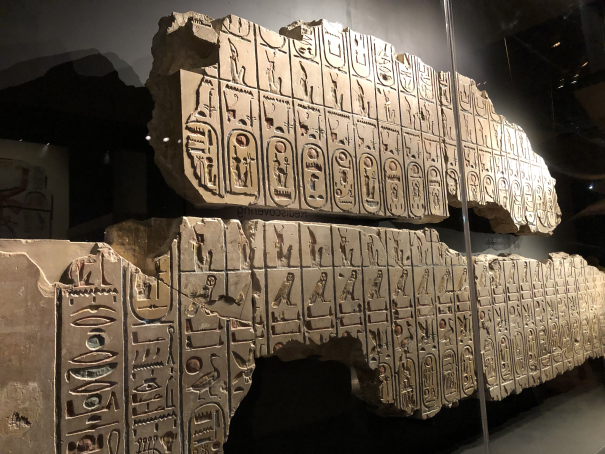
History of kings of Egypt, as commissioned by Rameses II. Description explains that he removed from the list foreign kings, women kings, and 'heretic' royalty, without explaining what Rameses II considered to be "heretic". Rameses II is also known as Ozymandias. We can therefore look on his work and despair.
Rameses II was a redhead, which in Ancient Egypt was not a good thing - Set, the chosen patron god of a "foreign" dynasty of Hyksos and later the villain opposing Osiris, was said to be a redhead. Rameses' II father was called Seti, after the god. Rameses II removing foreign kings from the list sounds a bit like he was attempting to erase his inconvenient background.
Literally a Type of Guy
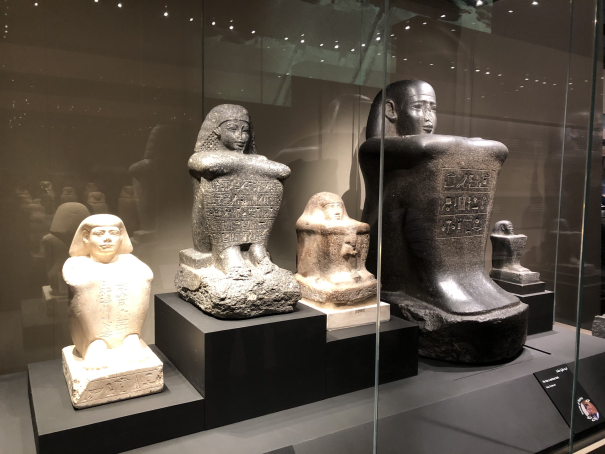
The exhibit label says that this was one of typical postures for non-royal sculptures, frequently copied after 1900 BCE. Some guy sits on the ground, hugs his knees and is wrapped in a cloak. Relatable.
The Internet is for Cats
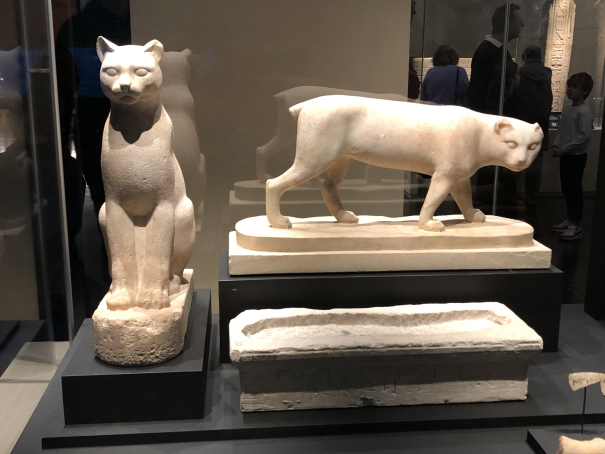
This one is for the cat lovers! The sculptures are an offering from a Greek woman left in the temple of Bubastis. One of the cats is portrayed in the typical Egyptian style and one in the more realistic Greek style.
Is this all?
No! The exhibition is vast. A large part of it is devoted to the history of deciphering the hieroglyphs which I skipped here entirely, and another part to the role of text in the culture of Ancient Egypt. I strongly recommend experiencing it in person - followed by a visit to room 4 (Egyptian sculpture) and 61 - 66 (Egyptian life and death).